Grok 4.5 API Pricing: Cost Calculator and Model Comparison
Verified July 2026 Grok 4.5 API prices: cached and long-context rates, monthly cost examples, and comparisons with GPT-5.5, Opus 4.8, and Fable 5.
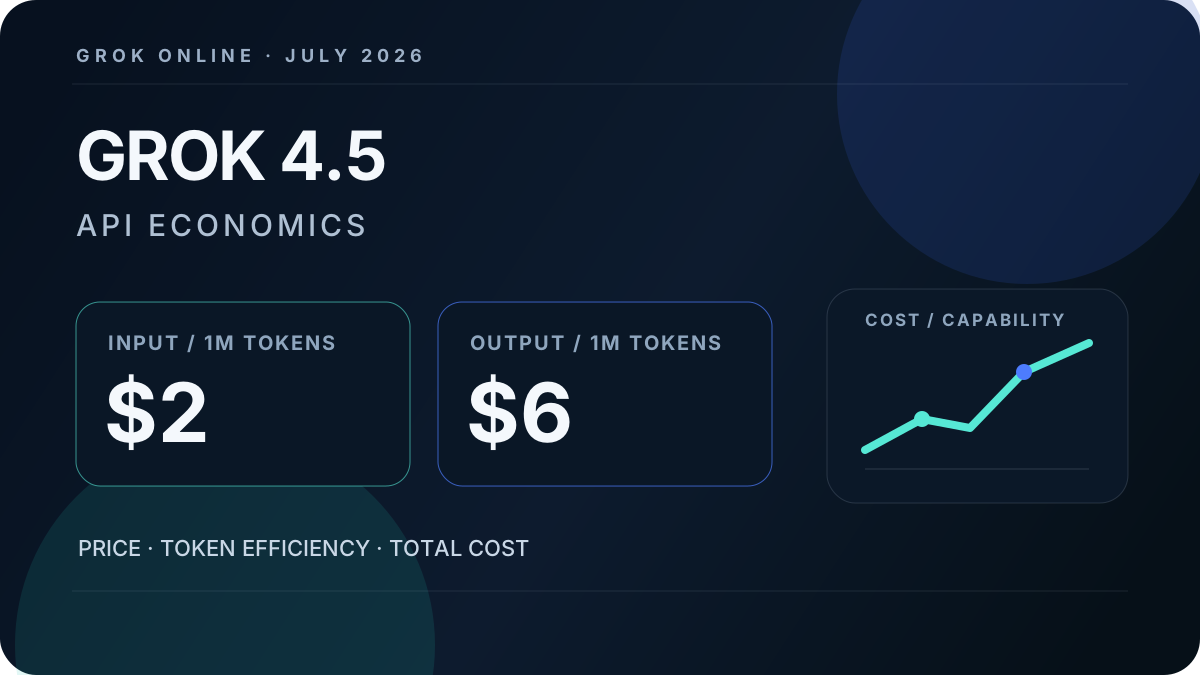
Grok 4.5 costs $2 per million input tokens and $6 per million output tokens for prompts below 200K tokens. Cached input is $0.30 per million. Once a prompt reaches 200K tokens, SpaceXAI applies long-context rates of $4 input, $0.60 cached input, and $12 output per million tokens.
That threshold is important: the widely quoted "$2/$6" headline is correct, but it is not the complete price schedule. This guide uses SpaceXAI's live pricing page, checked on July 23, 2026.
For capability and benchmarks, see our Grok 4.5 coding review. New to the product family? Start with What is Grok?.
Official Grok 4.5 API rates
Prices are in US dollars per one million tokens:
| Request type | Input | Cached input | Output |
|---|---|---|---|
| Prompt below 200K tokens | $2.00 | $0.30 | $6.00 |
| Prompt at or above 200K tokens | $4.00 | $0.60 | $12.00 |
The Grok 4.5 model documentation lists a 500K-token context window, a February 1, 2026 knowledge cutoff, and low, medium, or high reasoning effort. The model accepts text and images and returns text.
Tool calls can add separate charges. Web Search, X Search, code execution, and other server-side tools should be included in a production budget rather than treated as free model features.
Grok 4.5 versus other flagship API prices
The comparison below uses standard, non-batch, global API rates for short-context requests. It excludes caching, tools, priority processing, and data-residency premiums.
| Model | Input / 1M | Output / 1M | Context listed by vendor |
|---|---|---|---|
| Grok 4.5 | $2 | $6 | 500K |
| Claude Opus 4.8 | $5 | $25 | 1M |
| GPT-5.5 | $5 | $30 | 1M |
| Claude Fable 5 | $10 | $50 | 1M |
Sources: SpaceXAI pricing, OpenAI's GPT-5.5 announcement, and Anthropic pricing.
At the listed short-context rates, Grok 4.5 input is 60% cheaper than Opus 4.8 and GPT-5.5, while its output is 76% cheaper than Opus 4.8 and 80% cheaper than GPT-5.5. This is a price comparison, not a claim of equal task quality.
Monthly cost examples
Example 1: 100M input and 20M output tokens
Assume every prompt stays below 200K tokens and there are no cache hits, tools, batch discounts, or failed retries:
| Model | Input cost | Output cost | Monthly total |
|---|---|---|---|
| Grok 4.5 | $200 | $120 | $320 |
| Claude Opus 4.8 | $500 | $500 | $1,000 |
| GPT-5.5 | $500 | $600 | $1,100 |
| Claude Fable 5 | $1,000 | $1,000 | $2,000 |
Formula:
Monthly model cost = input tokens × input rate + cached tokens × cached rate + output tokens × output rate
Example 2: the same workload with 70% cached input
For Grok 4.5, 70M cached and 30M uncached input tokens plus 20M output tokens cost:
- uncached input: 30 × $2 = $60;
- cached input: 70 × $0.30 = $21;
- output: 20 × $6 = $120;
- total: $201, before tools and retries.
Caching saves $119 relative to the uncached $320 example. The result depends on actual cache eligibility and hit rate.
Example 3: long-context prompts
If the workload crosses the 200K-prompt threshold, the same 100M input and 20M output tokens would cost:
- input: 100 × $4 = $400;
- output: 20 × $12 = $240;
- total: $640 before caching and tools.
Long context can still be economical if it prevents retrieval failures or repeated calls, but it should be measured rather than assumed.
Why price per token is not total cost
Token efficiency changes the bill
SpaceXAI reports that Grok 4.5 used an average of 15,954 output tokens per resolved SWE-Bench Pro task, versus 67,020 for Opus 4.8 max, or about 4.2 times fewer. That result comes from one benchmark and one setup. It is useful evidence of possible efficiency, not a universal conversion factor.
A cheap failed task is still expensive
Retries, tool calls, test runs, and senior review can outweigh the model bill. A better operating metric is:
Cost per accepted task = model tokens + tool charges + retries + infrastructure + human review
Track accepted-task rate beside spend. Otherwise a low token price can hide a high operational cost.
Latency has two parts
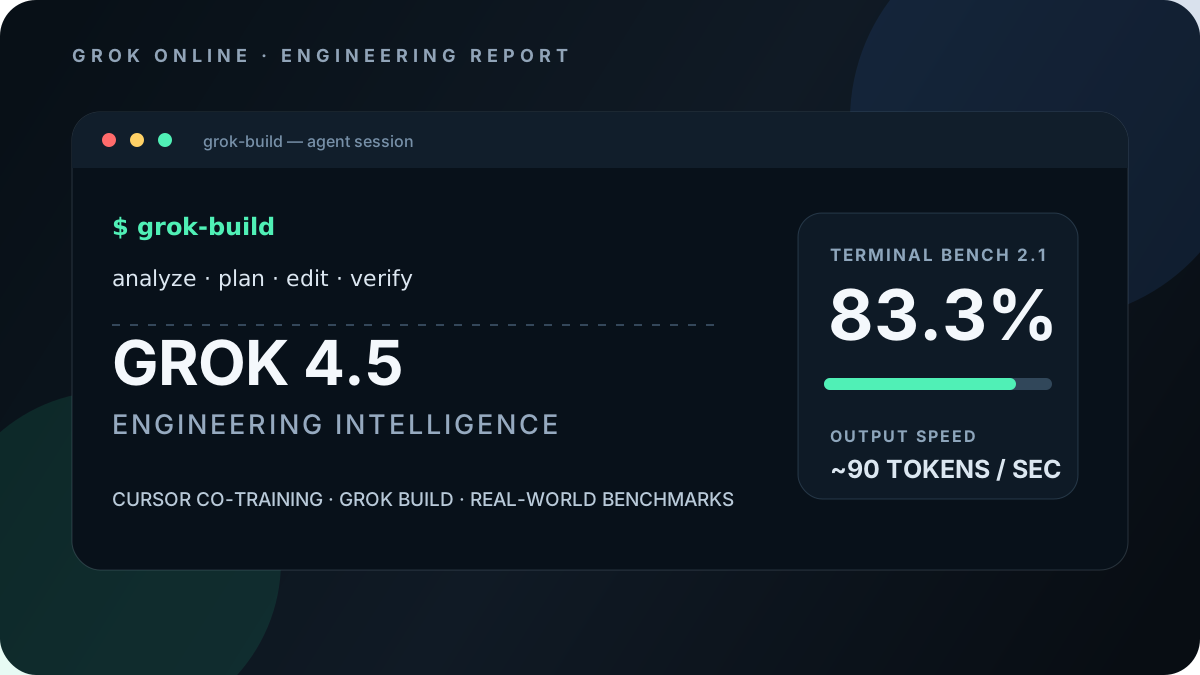
SpaceXAI advertises Grok 4.5 serving at about 80 tokens per second. Independent measurements vary with load and request shape; Artificial Analysis currently reports about 69.8 output tokens per second and an 8.54-second time to first token for its tested high-reasoning configuration.
Throughput matters for long answers. Time to first token matters for chat, voice, and interactive support. Benchmark both on your own traffic.
Different tokenizers distort "same tokens" comparisons
Anthropic states that Opus 4.7 and later, including Opus 4.8 and Fable 5, use a newer tokenizer that produces roughly 30% more tokens for the same text, depending on the workload. Comparing a fixed token count is convenient for billing math but may not represent the same amount of source text across providers.
When Grok 4.5 is a strong candidate
- high-volume coding, review, and repository agents;
- research or document workflows with substantial output;
- tasks that benefit from Web Search, X Search, or code execution;
- teams that can validate results automatically;
- applications where 500K context is sufficient and prompts usually remain below 200K.
Be cautious when first-token latency is critical, the prompt regularly crosses 200K tokens, data residency is mandatory, or your hardest defects need the highest possible success rate.
A practical evaluation plan
- Sample at least 50 representative tasks, including failures and edge cases.
- Run each model with equivalent tools, timeouts, and acceptance tests.
- Record uncached input, cached input, output, tool charges, retries, and wall time.
- Blind-review quality where automated tests are insufficient.
- Compare cost per accepted task and the 95th-percentile latency.
- Route high-risk or repeatedly failed tasks to a stronger model or a human.
Frequently asked questions
How much does the Grok 4.5 API cost?
Below 200K prompt tokens, it costs $2 per million input tokens, $0.30 per million cached input tokens, and $6 per million output tokens. At 200K prompt tokens or more, those rates double to $4, $0.60, and $12.
Is Grok 4.5 cheaper than GPT-5.5?
At standard short-context list prices, yes: Grok 4.5 is 60% cheaper on input and 80% cheaper on output. Actual savings depend on tokenization, task success, tools, caching, and retries.
Does Grok 4.5 support a 500K context window?
Yes. The official model page lists 500K tokens. Long-context pricing begins earlier, when the prompt reaches 200K tokens.
Are Web Search and X Search included in the token price?
Do not assume so. Server-side tools may carry usage charges in addition to tokens; check the live pricing page and your console.
Is the cheapest model always the best choice?
No. The relevant measure is cost per accepted task, including rework and review. Use your own evaluation set before switching production traffic.
Sources
- SpaceXAI Developers: Pricing
- SpaceXAI Developers: Grok 4.5
- SpaceXAI: Introducing Grok 4.5
- Cursor: Introducing Grok 4.5
- OpenAI: Introducing GPT-5.5
- Anthropic: Claude API pricing
- Artificial Analysis: Grok 4.5
Prices and measurements last checked July 23, 2026. Vendor rates, limits, and benchmark results change; verify the linked live documentation before purchasing.