Grok 4.5 Coding Review: Cursor, Grok Build and Benchmarks
Verified Grok 4.5 coding review: Cursor co-training, Grok Build, Terminal-Bench and SWE results, plus an evaluation plan for engineering teams.
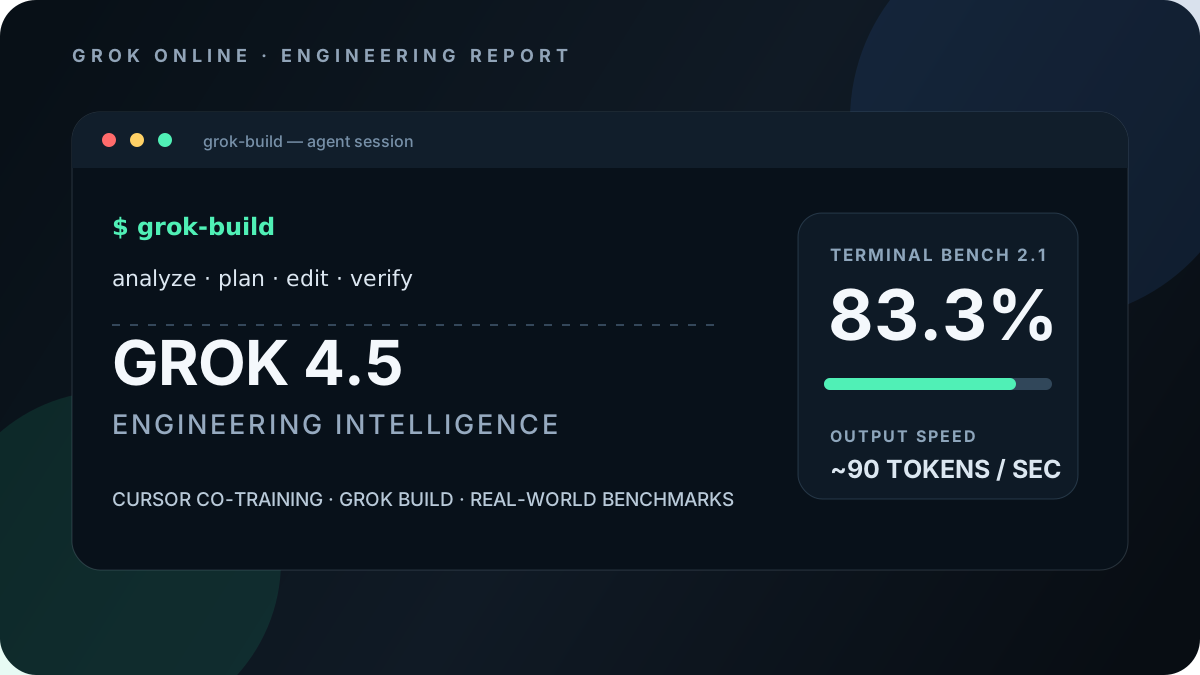
Grok 4.5 is a competitive coding and agentic model, especially for terminal work, long-running tasks, and cost-sensitive engineering automation. It scored 83.3% on Terminal-Bench 2.1 and 29% on SWE Marathon in SpaceXAI's published comparison, but it did not lead every software benchmark: it scored 53% on DeepSWE 1.1 and 64.7% on SWE-Bench Pro.
The balanced conclusion is not "best coding model." It is that Grok 4.5 combines frontier-level engineering performance, concise tool trajectories, a 500K context window, and low API pricing. Teams should validate that combination against their own repositories.
For billing details, read our Grok 4.5 API pricing guide. For broader product context, see What is Grok?.
Why Grok 4.5 is different from a code autocomplete model
Real software tasks are not isolated programming questions. An agent must search an unfamiliar repository, inspect dependencies, run commands, interpret failures, edit multiple files, and prove the change works.
Cursor's launch report says Grok 4.5 is a mixture-of-experts model jointly trained with SpaceXAI. Its training included trillions of tokens of Cursor data covering codebases, software tools, and developer-agent interactions. Cursor also used broader STEM tasks, research papers, and knowledge work rather than training a code-only specialist.
According to SpaceXAI's announcement, reinforcement learning covered hundreds of thousands of multi-step software engineering and technical tasks. Agent rollouts could run for hours, with automated and model-based grading.
What is public and what is not:
| Item | Verified status |
|---|---|
| Architecture | Cursor identifies it as mixture of experts |
| Joint training | Confirmed by Cursor and SpaceXAI |
| Cursor training data | Trillions of tokens from codebases and developer-agent interactions |
| Training hardware | Tens of thousands of NVIDIA GB300 GPUs |
| Context window | 500K tokens |
| Parameter count | Not disclosed |
| Model weights | Proprietary |
Claims such as "1.5 trillion parameters" are not supported by the official model page or Cursor's report.
Grok 4.5 coding benchmarks
These figures come from SpaceXAI's release page. The company notes that competitor results come from vendor system cards or benchmark leaderboards, and the harness is not identical for every row.
| Benchmark | Grok 4.5 | GPT-5.5 | Opus 4.8 | Fable 5 | What it tests |
|---|---|---|---|---|---|
| DeepSWE 1.0 | 62.0% | 64.31% | 55.75% | 66.1% | Repository tasks with provider harnesses |
| DeepSWE 1.1 | 53% | 67% | 59% | 70% | GitHub issue solving in a common mini-swe-agent harness |
| SWE Marathon | 29% | not listed | 26% | 24% | Long-horizon software tasks |
| Terminal-Bench 2.1 | 83.3% | 83.4% | 78.9% | 84.3% | Complex command-line workflows |
| SWE-Bench Pro | 64.7% | 58.6% | 69.2% | 80.4% | Difficult real-world issue resolution |
Terminal-Bench is the clearest strength
Grok 4.5's 83.3% is effectively tied with GPT-5.5's 83.4% and one point behind Fable 5. That makes it a credible candidate for build repair, dependency diagnosis, data scripts, DevOps tasks, and other work that happens through a terminal.
DeepSWE 1.1 shows the limit
Under a common mini-swe-agent harness, Grok 4.5's 53% trails the three more expensive comparison models. For high-risk, cross-file defects where the highest success rate matters more than cost, a stronger model or escalation route may be justified.
Harnesses matter as much as model names
DeepSWE 1.0 allows provider-specific harnesses, whereas DeepSWE 1.1 uses a shared agent framework. Tools, permissions, timeouts, reasoning effort, token budgets, and validators can materially change a score. Compare models only when the execution environment is controlled.
Cursor also disclosed that an earlier snapshot of its own codebase was accidentally included in training. This could advantage Grok 4.5 on CursorBench, so Cursor excluded that result from its launch comparison. That disclosure is a useful warning against treating any benchmark close to training data as neutral.
Token efficiency and speed
SpaceXAI reports that Grok 4.5 averaged 15,954 output tokens per SWE-Bench Pro task, versus 67,020 for Opus 4.8 max: about 4.2 times fewer. Shorter trajectories can reduce cost, wall time, and context pressure.
SpaceXAI advertises roughly 80 tokens per second. Artificial Analysis currently measures about 69.8 tokens per second and an 8.54-second time to first token for its tested high-reasoning API configuration. Differences are expected because serving load, prompts, and methodology vary.
Token efficiency is useful only when the task passes. Track tests, review corrections, and retries alongside tokens.
Grok Build: the agent around the model
Grok Build is SpaceXAI's terminal-native coding agent. Grok 4.5 is now its default model. The product supports:
- plan review and approval before execution;
- repository search, file editing, terminal commands, and diffs;
- parallel subagents and worktree integrations;
- project instructions such as
AGENTS.md; - skills, plugins, hooks, MCP servers, and ACP;
- headless execution for scripts and automation.
On July 15, 2026, SpaceXAI open-sourced the Grok Build harness. The repository includes context assembly, tool dispatch, the agent loop, terminal UI, and extension loading. This makes the runtime inspectable and self-hostable, but the default Grok 4.5 model remains proprietary.
SpaceXAI also operates a Grok Build plugin marketplace with integrations such as MongoDB, Vercel, Sentry, Chrome DevTools, and Cloudflare. Remote plugins are pinned to commit SHAs, but teams should still review permissions and code before installation.
Grok 4.5 in Cursor
Cursor makes Grok 4.5 available on desktop, web, iOS, CLI, and its SDK. Cursor's listed model rates are:
| Cursor variant | Input / 1M | Output / 1M |
|---|---|---|
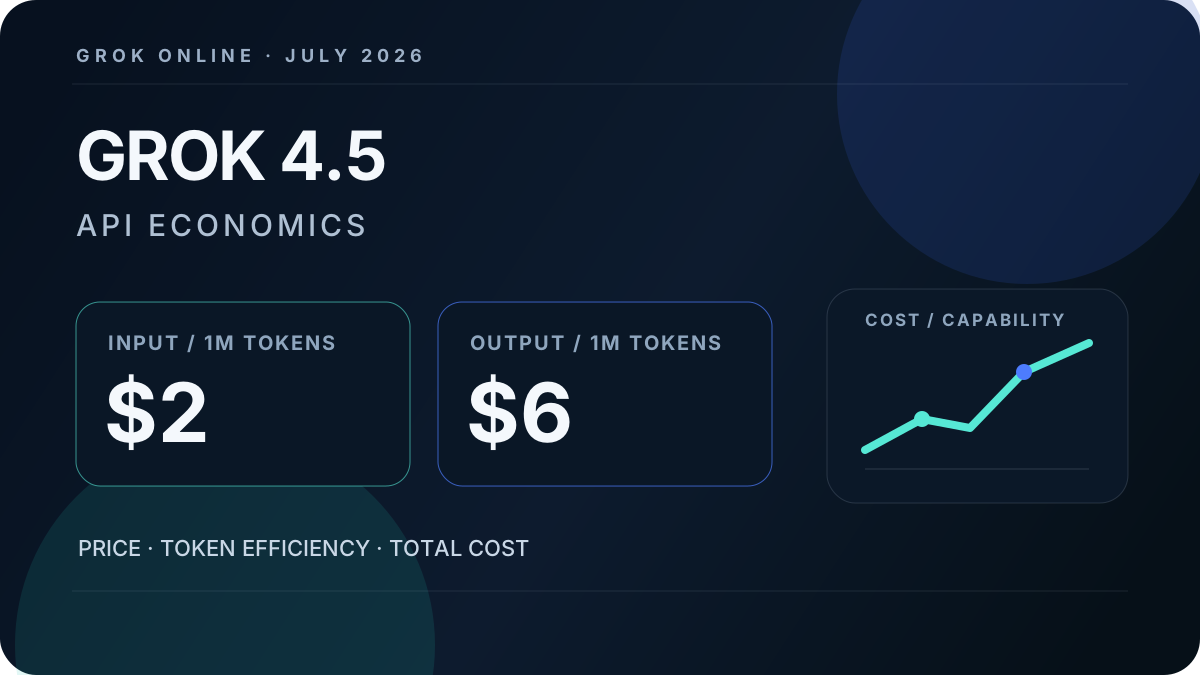
| Grok 4.5 base | $2 | $6 |
| Grok 4.5 fast | $4 | $18 |
The fast variant trades a higher token rate for faster serving. Whether it saves money depends on the value of developer wait time and whether lower latency improves throughput.
Calling Grok 4.5 through the API
curl https://api.x.ai/v1/responses \
  -H "Content-Type: application/json" \
  -H "Authorization: Bearer $XAI_API_KEY" \
  -d '{
    "model": "grok-4.5",
    "input": "Inspect the failing test, propose the smallest fix, implement it, and list the validation you performed."
  }'
The developer page lists Responses and Chat Completions APIs, configurable reasoning, and function calling, web search, X search, and code execution.
For production coding agents:
- run commands in an isolated environment;
- scope credentials and network access to the minimum;
- require tests and a clean diff before completion;
- block destructive commands behind approval;
- log model, reasoning level, tools, tokens, and retries;
- require human review for security, auth, payments, and infrastructure.
Where Grok 4.5 fits
Strong default candidates
- terminal work, build fixes, and routine debugging;
- high-volume code generation, tests, refactors, and documentation;
- agent queues with automated acceptance tests;
- long-running tasks that need a 500K context window;
- cost-sensitive workflows with substantial output.
Good first tier in a model router
Use Grok 4.5 for the first attempt, then escalate when tests fail twice, the change touches a high-risk subsystem, or uncertainty remains. Routing often yields a better cost-quality balance than forcing one model to handle every task.
Cases that still need careful testing
- difficult cross-file defects;
- repositories with weak test coverage;
- real-time pair programming where first-token delay is disruptive;
- regulated code or strict data-residency requirements;
- security-sensitive tasks with powerful terminal access.
How to evaluate it on your repository
- Build a set of 30-100 completed historical issues.
- Include feature work, regressions, flaky tests, dependency failures, and documentation.
- Give each model the same commit, tools, timeout, and instructions.
- Grade with tests first, then blind human review.
- Record pass rate, time, tokens, tool calls, retries, and reviewer edits.
- Run adversarial checks for secret leakage, privilege escalation, unsafe commands, and dependency attacks.
- Rank by accepted-task cost, not API price alone.
Frequently asked questions
Is Grok 4.5 the best coding model?
There is no single defensible "best" across all tasks. Grok 4.5 is near the top on Terminal-Bench 2.1 and leads the listed SWE Marathon comparison, but trails some models on DeepSWE 1.1 and SWE-Bench Pro.
What is Cursor's role in Grok 4.5?
Cursor jointly trained the model with SpaceXAI and supplied trillions of tokens representing codebases and developer-agent interactions. Cursor also serves the model in its products.
What is the difference between Grok Build and Grok 4.5?
Grok 4.5 is the model. Grok Build is an agent harness and terminal interface that gives a model tools, repository context, permissions, and a validation loop.
Is Grok Build open source?
Yes, its harness is open source as of July 15, 2026. Grok 4.5's model weights are not.
How many parameters does Grok 4.5 have?
SpaceXAI and Cursor have not published a parameter count. Treat numbers circulating without a primary source as unverified.
Sources
- SpaceXAI: Introducing Grok 4.5
- Cursor: Introducing Grok 4.5
- SpaceXAI: Introducing Grok Build
- SpaceXAI: Grok Build is open source
- SpaceXAI: Grok Build Plugin Marketplace
- SpaceXAI Developers: Grok 4.5
- Artificial Analysis: Grok 4.5
Last fact-check: July 23, 2026. Benchmarks and product availability change; preserve the test date and harness when citing a result.